Morton
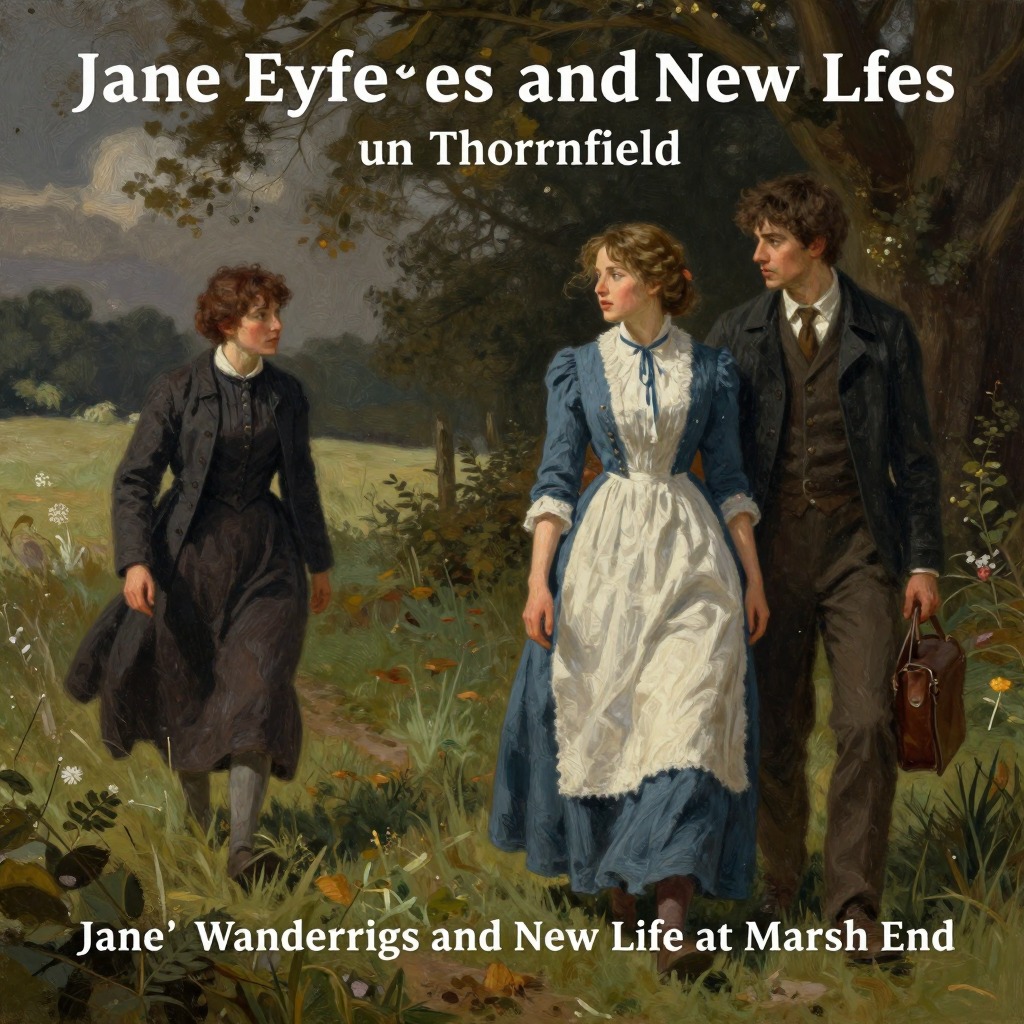
Morton is the secluded village in a north-midland shire that becomes Jane Eyre's refuge and turning point after her desperate flight from Thornfield Hall. It is here, in this landscape of moors, hills, and a single winding street, that Jane, having nearly died of hunger and exposure, is taken in by the Rivers family, discovers she is their cousin, inherits twenty thousand pounds, and finally resists St. John Rivers's proposal to join him as a missionary wife. Morton thus functions as the site of Jane's material and emotional independence, the place where she chooses principle over passion and, paradoxically, where she receives the supernatural call that leads her back to Rochester.
Geography and Setting
Morton lies in a valley surrounded by moors and hills, with a stream running through it. The village itself is small, containing a single street, a church, a parsonage, a few shops, and a needle-factory and iron-foundry owned by the wealthy Mr. Oliver. The surrounding landscape is wild and beautiful: Jane describes "great moors" and "waves of mountains" beyond a deep valley, and she often walks through fields and along bridle-paths to reach the parsonage or the grander Vale Hall. The climate is harsh—snowdrifts can block the roads in winter—but the spring and summer bring "blue sky, placid sunshine, and soft western or southern gales." The isolation of Morton is emphasized by its distance from any large town; the nearest city, S—, is twenty miles away.
Jane's Life as Schoolmistress
After being rescued by St. John Rivers and his sisters, Jane accepts the position of village schoolmistress at Morton, a post St. John had established for the poor girls of the parish. Her cottage, attached to the school, is furnished simply but adequately, thanks to the kindness of Rosamond Oliver, the wealthy heiress of Vale Hall. Jane teaches twenty scholars at first, most of whom are illiterate and speak with a broad local accent. She finds the work hard but rewarding, and over time she gains the affection and respect of her pupils and their families. She becomes "a favourite in the neighbourhood," greeted with cordial salutations and friendly smiles wherever she goes. Yet despite this contentment, Jane is haunted by dreams of Rochester and by the unresolved pain of her departure from Thornfield.
The Rivers Family and the Discovery of Kinship
Morton is the home of the Rivers family, who live at Marsh End (also called Moor House), a small, ancient grange set among firs and moors. St. John Rivers is the young, handsome, and austere clergyman of Morton; his sisters, Diana and Mary, are intelligent, well-read, and kind. Jane forms a deep bond with the sisters, and St. John, after initially keeping his distance, comes to respect her abilities. The pivotal revelation occurs when St. John discovers that Jane is his cousin: their mothers were sisters, and their uncle, John Eyre of Madeira, has left Jane a fortune of twenty thousand pounds. Jane immediately insists on sharing the inheritance equally with her three cousins, and the transfer is legally effected. This discovery transforms Jane from a destitute wanderer into an independent heiress with a family.
St. John's Proposal and Jane's Refusal
St. John, having recognized Jane's strength of character and intellect, asks her to marry him and accompany him as a missionary to India. He does not love her in a romantic sense but sees her as an ideal helpmeet for his vocation. Jane respects and admires him but refuses, knowing that such a marriage would be a "martyrdom" and a violation of her true self. The conflict reaches its climax in a walk through the glen near Morton, where St. John presses his suit with relentless logic and spiritual authority. Jane's refusal is firm, and she tells him she will go to India only as his sister, not his wife. This decision, made in the very landscape of Morton, marks the triumph of her integrity over the pressure of duty and the allure of a noble cause.
The Supernatural Call and Departure
It is in Morton, on the night after St. John's final plea, that Jane hears the mysterious, supernatural voice of Rochester calling her name—"Jane! Jane! Jane!"—a cry that seems to come from nowhere and everywhere, and that she answers with an immediate resolve to return to him. The next morning she leaves Morton for Thornfield, traveling by coach from Whitcross, the crossroads near the village. Morton thus serves as the threshold between Jane's life of principled solitude and her reunion with the man she loves. The village and its surrounding moors remain a place of profound personal transformation, where Jane gains family, fortune, and the moral clarity to follow her own heart.